The roast date printed on a bag of whole-bean coffee doesn’t guarantee a satisfying cup. The Specialty Coffee Association describes freshness as a gradual process: after roasting, CO₂ escapes, while aromatic compounds change and then dissipate depending on the roast profile, packaging and storage conditions.
Beans roasted the day before can disappoint just as much as beans from an opened bag that’s been sitting for three weeks if degassing isn’t complete or the bag isn’t properly resealed between uses.
Bag size and how quickly you drink it: the real freshness criteria
Buying a kilo of whole-bean coffee because the price per kilo is lower is a common habit. The problem becomes apparent in the second week: an opened bag loses aromatic complexity, especially if its degassing valve doesn’t allow it to be sealed airtight again.
Whole beans keep better than ground coffee, but their shelf life has its limits. A 250 g bag used up in ten days retains a clearer aromatic profile than a kilo that takes six weeks to finish. The calculation is simple: estimate your weekly consumption in cups, convert that to grams (about two doses a day for a regular coffee drinker), then choose a bag size you’ll finish before the aromas fade.
Knowing how to choose good whole-bean coffee also means thinking about logistics—something often overlooked in favor of origin or tasting scores alone.
- Low consumption (one cup a day): choose 250 g bags with a valve and resealable zip.
- Average consumption (two to three cups a day): a 500 g bag will last about two weeks, which is still within the ideal freshness window.
- High consumption (four or more cups a day): a kilo makes sense, provided you store it in an opaque, airtight container at a stable temperature.
Roast profile and brewing method: finding the right match
Roast level has a greater impact on the taste in the cup than geographic origin. A light roast of washed Ethiopian arabica produces floral notes and bright acidity in a V60, but makes for an acidic, thin espresso on a grinder machine set up for an Italian-style profile.
Dark roasts develop body and cocoa or caramel notes at the expense of acidity and fruity aromas. They’re more forgiving of variations in grind size and temperature. Light roasts require more precise extraction: water temperature between 92 and 96 °C, a controlled dose-to-water ratio and a properly calibrated grind.
Espresso and machines with built-in grinders
Built-in grinders rarely offer fine enough adjustments to get the most out of a very light roast. A medium or medium-dark profile is a more suitable choice for this type of machine. The beans also need to be dry enough not to clog the burrs, ruling out some very oily dark-roasted natural coffees.
Manual brewing methods: filter, French press, pour-over
These methods extract more slowly and bring out aromatic complexity. A light to medium roast is better suited to manual brewing because the longer contact time extracts more delicate soluble compounds without bringing out too much bitterness.
Arabica, robusta and blends: beyond the marketing
The label “100% arabica” says nothing about the actual quality of the beans. Commercial Brazilian arabica, mechanically harvested and industrially roasted, won’t match specialty Ugandan robusta for aroma. Botanical variety is an indicator, not a guarantee of quality.
Arabica accounts for most of the world’s coffee production and offers a broader range of aromas (fruity, floral, tangy). Robusta adds body and crema, and contains about twice as much caffeine. Blends combine these characteristics to create a balanced profile, often tailored for espresso.
- Specialty arabica: look for traceable lots that identify the producer, region and processing method (washed, natural, honey).
- Fine robusta: still rare, it stands out for its hazelnut and dark chocolate notes, without the harshness of commercial robusta.
- Espresso blend: check the exact composition (arabica/robusta percentage) rather than relying on a vague “house blend” label.
Whole-bean coffee traceability: what EU regulations will change
The European Union Deforestation Regulation (EUDR), amended in December 2025, is set to apply from 30 December 2026 to large and medium-sized operators, and from 30 June 2027 to certain small and micro-enterprises. The regulation requires supply chains to be documented back to the production plot.
For consumers, the practical impact will be gradual. Traceability will become a verifiable purchasing criterion, rather than just a claim. Roasters that already work directly with identified cooperatives or producers will have little difficulty adapting. Brands that blend anonymous lots will need to rethink their sourcing.
For now, asking the seller where the lot comes from, how it was processed and when it was roasted remains the best way to verify information that isn’t always on the bag.
Compare whole-bean coffees using the same recipe
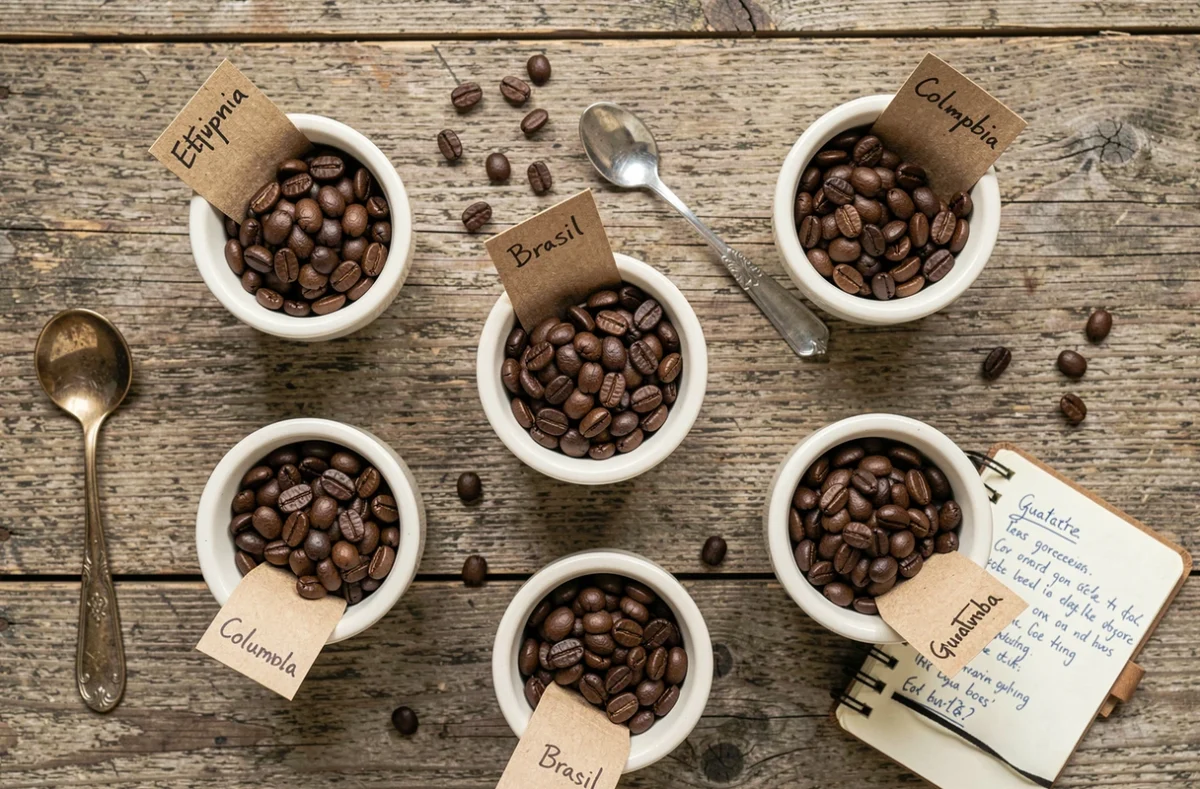
Trying different origins or roasts only makes sense if you keep the brewing method the same from one test to the next. Changing both the beans and the grind, or the beans and the temperature, makes it impossible to isolate what you like or dislike. A noticeable difference and a personal preference are two different things.
Set a ratio (for example, 15 g of coffee to 250 ml of water for filter brewing), a grind size and a temperature. Change only the coffee. Note what you taste: acidity, bitterness, body and finish. Two or three tests are enough to identify your taste preferences and guide your next purchases.
Whole-bean coffee rewards consistency more than the hunt for a rare lot. A bag suited to your routine, stored properly and brewed with a well-controlled method will make for a more satisfying cup than a premium coffee that’s been stored poorly or prepared in a hurry.