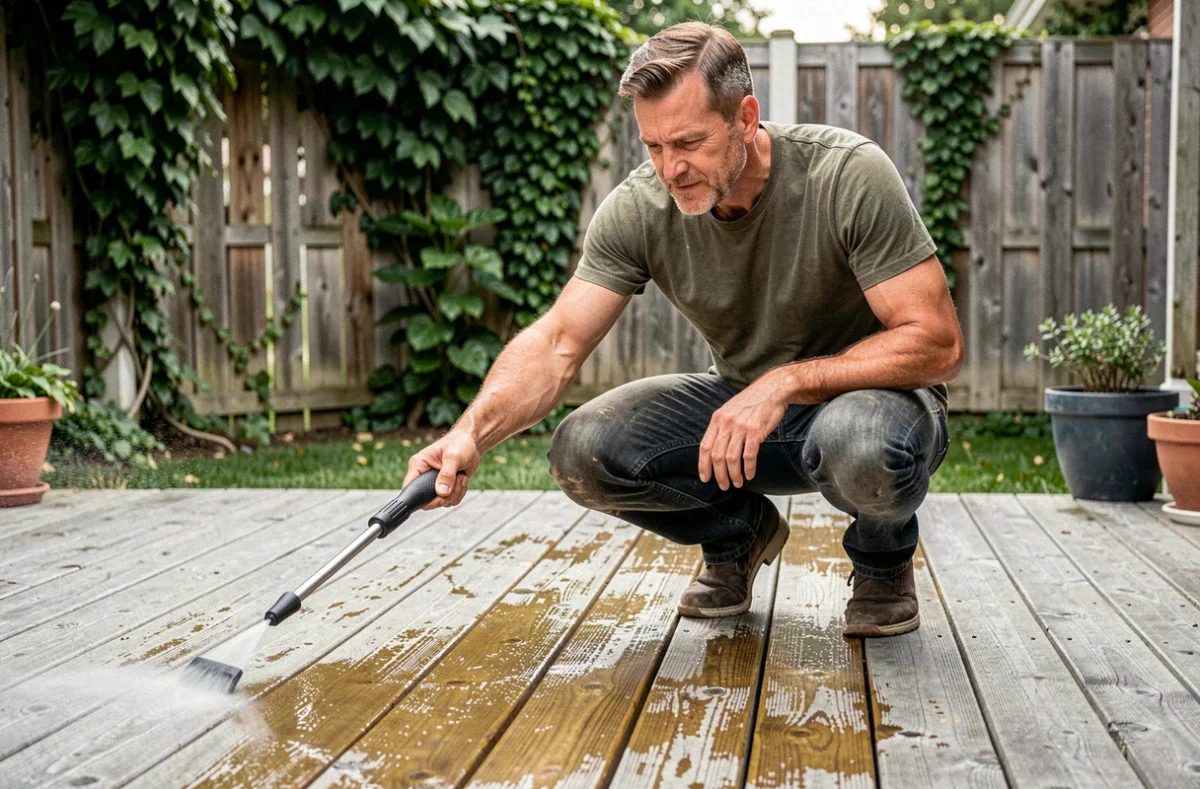
The pressure washer sprays water with enough force to strip away embedded moss from concrete. When applied to a wooden deck, this same force can damage the surface instead of renovating it. The question of using a Kärcher on wood is not a simple yes or no: it depends on the type of wood, the settings, and the condition of the boards before intervention.
Wood fibers and high-pressure jet: what happens at the surface
Wood is a fibrous material, structured in layered sections. When a high-pressure jet hits the surface, it does not just remove dirt. It can lift the surface fibers, especially on soft woods like pine or douglas fir.
At first, the deck appears clean. The problem arises during drying: the surface becomes rough, almost fuzzy. These lifted fibers harden and form splinters, which are unpleasant for bare feet.
A rarely highlighted point: wood made rough by the jet gets dirty faster. The raised fibers capture more dust, pollen, and moisture. The “deep cleaning” with a Kärcher can therefore shorten the interval between two maintenance sessions, creating a cycle where the deck requires increasingly frequent cleanings.
Before deciding to use a pressure washer, one must assess the current condition of the wood. If the boards are already rough or if fibers have been raised during a previous cleaning, light sanding is preferable. Applying a saturator to mechanically damaged wood does not repair the damage: the protection is applied to a healthy surface. Those considering cleaning a wooden deck with a Kärcher should check this point first.
Pressure setting and nozzle distance: the technical thresholds
Most domestic pressure washers exceed what wood can tolerate. The margin for maneuvering lies in two simultaneous parameters: the output pressure and the distance between the nozzle and the board.
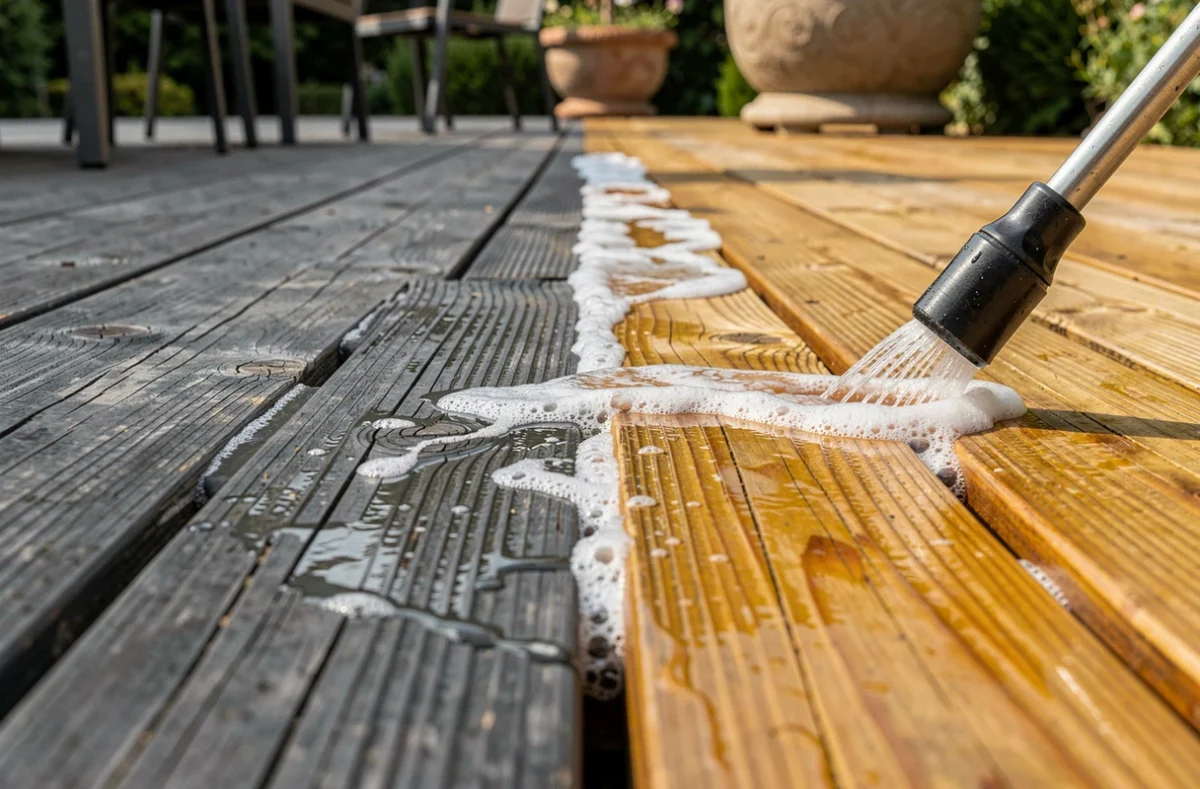
A minimum distance of about 30 cm between the nozzle and the wood is recommended by several manufacturers. The closer the nozzle, the more concentrated the impact force is on a smaller surface, increasing the risk of gouging or streaking the boards.
Nozzle and accessories suitable for wood
The rotary nozzle (or “rotary jet”) is the enemy of wood. Its concentrated, spinning jet carves visible grooves once the surface dries. Two alternatives work better:
- The rotary deck brush (or surface cleaner) maintains a constant distance and distributes pressure over a wider area, which limits the risk of localized marks.
- The flat jet nozzle, used at low pressure and with a steady motion, allows for the removal of deposits without concentrating the force on one point.
- A foam nozzle or an integrated detergent tank allows for the application of a gentle cleaner before rinsing, reducing the need to compensate for dirt with pressure.
The technique is as important as the equipment. Slow and steady back-and-forth motions, always in the direction of the fibers, avoid differences in shade. If the jet stays too long in one spot, it removes a thin layer of material, creating visible streaks upon drying.
Cleaning wooden decks without high pressure: methods that preserve the boards
The Kärcher should remain a one-time solution, not the usual maintenance method. For regular cleaning (once or twice a year), less aggressive approaches yield comparable results on a well-maintained deck.
A stiff-bristled broom, warm water, and a specific cleaner for wooden decks are sufficient to remove most common dirt. Diluted black soap also works, provided it is rinsed well to avoid leaving a greasy film.
The spaces between the boards, often neglected areas
Dead leaves and organic debris trapped between the boards retain moisture, especially in shaded areas. This persistent moisture promotes greening and the gradual degradation of the wood. A simple weeding knife or a fine spatula, used between the boards before cleaning, significantly improves the result.
This preparatory work does not require powerful jets. It also reduces the temptation to increase pressure to dislodge what is stuck in the gaps.
Drying and protection after cleaning: the step that determines longevity
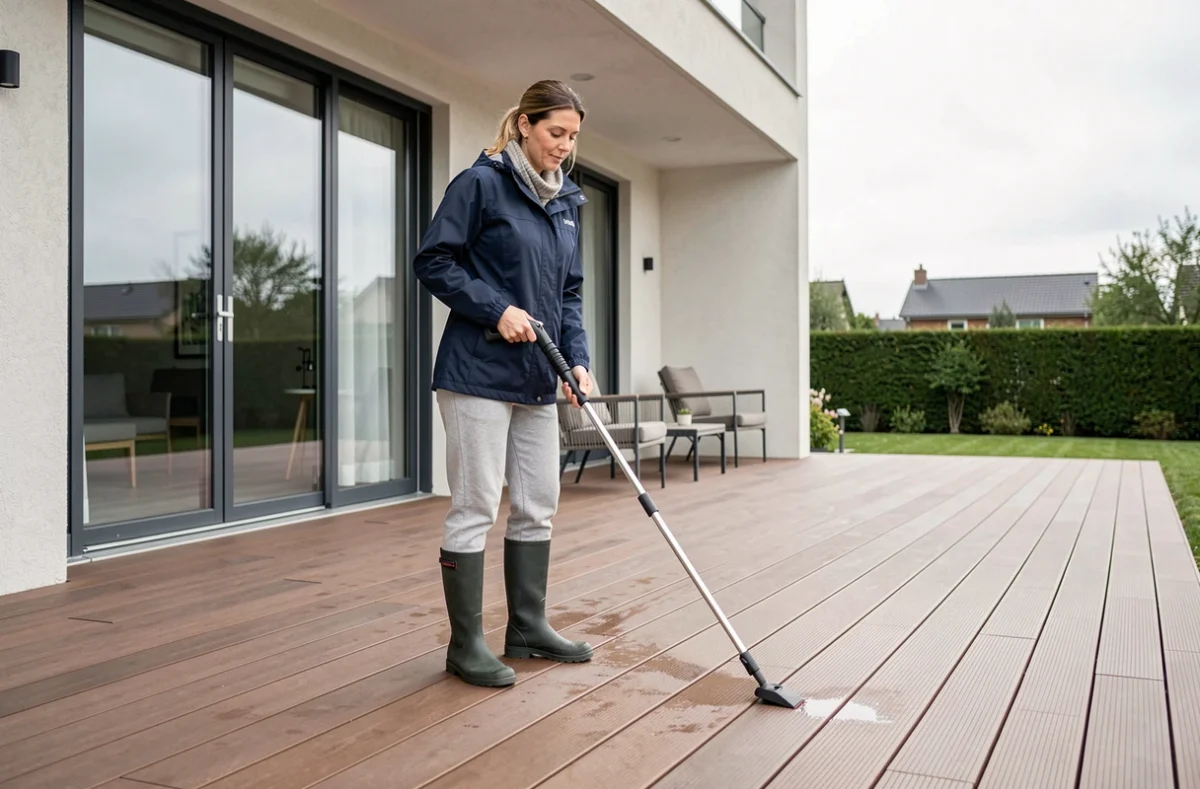
Cleaning and protecting are two distinct operations, separated by a drying time that is often underestimated. A few days without rain do not guarantee that the wood is ready to receive a saturator, especially on a thick deck or in a shaded area.
A moisture meter allows for checking the residual moisture content in the boards. Applying a protective product to still damp wood compromises the adhesion and penetration of the saturator, rendering the treatment partially ineffective.
The saturator nourishes the wood deeply and protects it from graying. It does not form a surface film (unlike a varnish), which avoids peeling problems. On a deck that has been cleaned with a Kärcher and then lightly sanded, the saturator penetrates better and offers more durable protection.
The frequency of application depends on exposure: a south-facing deck subjected to UV rays requires more frequent renewal than a partially covered deck. The water droplet test (if it beads, the protection still holds; if it is absorbed, it needs to be reapplied) remains the simplest way to judge the right moment.
The pressure washer is neither prohibited nor recommended on a wooden deck. Used at low pressure, with a surface cleaner, at a good distance, and on wood in decent condition, it can be useful on occasion. Making it the default cleaning method accelerates the wear of the boards and commits one to increasingly burdensome maintenance.